The Yarra Valley is no stranger to conspiracy theories, and the causes of major disasters are no exception.
A particularly prominent rumour that has garnered thousands of interactions on Facebook was shared in a local noticeboard, highlighting how far these theories can reach and spread.
A 2025 paper from Deakin University’s Centre for Resilient and Inclusive Societies (CRIS) called ‘Crisis Points: Countering Extremism in a State of Emergency’ explored how natural disasters can ‘provide fodder for violent extremist groups and contribute to a mobilisation to violence’.
Co-author Mark Duckworth, who is also a co-director and senior research fellow of CRIS, said this is part of a global phenomenon that we are seeing in a decline of trust in government and government institutions, resulting in increases in polarisation, misinformation and disinformation.
“Some people have said that we are living in a in a post-truth world, which makes it particularly challenging for emergency services organisations who clearly rely upon their information being understood and acted on,” he said.
“Trust is the glue that binds our society together, we require trust between communities and between communities and governments and institutions and when that begins to fray, then that creates some problems for us.
“The World Economic Forum puts out a global risk report…over the next two years, the number one risk they have listed is misinformation anddisinformation, and the number two risk is extreme weather events and I think clearly what we’re talking about is the fact that these two risks are also interconnected.”
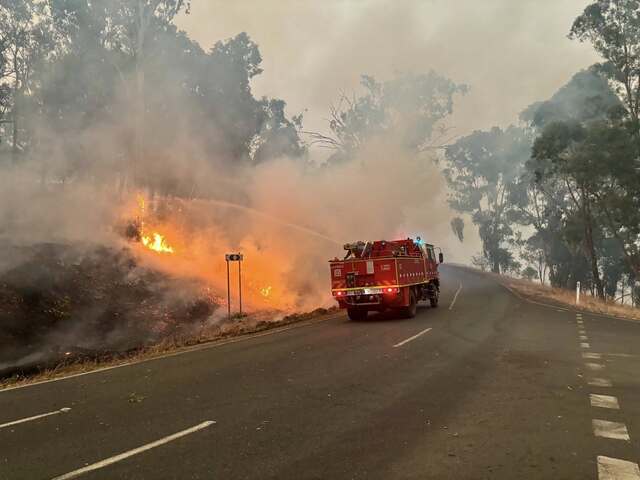
The Longwood fire conspiracy theory was shared by a member of a Facebook group focused on Healesville and had been originally posted by a page which claims to share news, information, photos, videos and events from Victoria.
The post theorised the potential use of ‘energy weapons’, or lasers, as a method of deliberately starting the fire to clear the way for the proposed Longwood–Eildon renewable energy transmission line of the VNI (Victoria to New South Wales Interconnector) West project or windfarms in the region. Claims of ‘unusual fire impacts’ such as homes being destroyed while nearby trees and vegetation remained intact are included in the post, which may have been sourced from another post on Facebook and one on X (formerly Twitter), which was viewed over 286,000 times. Australian Associated Press (AAP) FactCheck discredited these rumours by analysing drone footage and consulting experts in bushfire behaviour.
Mr Duckworth said there is a distinction we need to make between disinformation and misinformation.
“Disinformation is false information that is deliberately created to harm, mislead and create an emotional response in a target audience, it includes what we sometimes call fake news as well as propaganda, and is deliberately created to mislead and frequently designed to create division in society,” he said.
“Misinformation is false or misleading information, which is held and shared without intent to harm and this means that people often well-meaning people can unknowingly hold and spread false, harmful and misleading information.
“During emergencies and crisis events, there are people out there who create disinformation, but a lot of it is spread by people as misinformation who are unknowingly doing that…when people do not trust the information from government or the evidence of experts, they will turn to other sources and this includes misinformation and disinformation.”
This is not a new phenomenon, with the Covid-19 pandemic and the Black Summer bushfires, which were claimed to be lit to pave the way for high-speed rail, subject to conspiracy speculation.
Mr Duckworth said a lot of it can be linked to the global nature of social media.
“It used to be the case that the people would have we regard as slightly crazy views might hand out leaflets at street corners and reach a few hundred people but nowadays, these views can spread around the world and a lot of this disinformation and misinformation comes from other countries,” he said.
“There was an incident in July last year, when there were some widespread floods in Texas and there was a lot of material going around saying that these floods were linked to cloud seeding and not actually caused by natural occurrences.”
Energy weapons seem to be the subject of numerous conspiracy theories, including multiple fire events, but AAP Factcheck also discredited a video shared in August 2025 at a ‘March for Australia’ rally that claimed an acoustic hailing device, used by police to loudly and clearly issue directions, commands and alert tones, was an energy weapon or sonic weapon.
The Associated Press has reported that a long-range acoustic device (LRAD) was allegedly used at an anti-government protest in Serbia in 2025.
Victoria Police was reported by the ABC and other outlets to have purchased LRADs in 2016, which tend to be larger and attached to vehicles, but can be used in sieges or significant public order incidents. Conducted energy weapons (CEWs), commonly known as tasers, are also in use by police in Victoria.
Mr Duckworth said to combat the threat of misinformation and disinformation, we need to look at efforts like ‘pre-bunking’ with quick, accurate information and by building trust between government institutions and communities, as emergency services are already among the most trusted institutions in Australia.
“You can’t attempt to build those relationships during a crisis, they actually have to be developed before a crisis and continue after the crisis has gone, though I think governments and emergency services and recovery organisations have got a lot better at this in the last decade,” he said.
“Official sources can sometimes move more slowly than social media so we probably need to find ways of increasing the speed in which emergency services institutions can move to debunk some of these claims but this has to be done very carefully because the nature and power of official information is that is accurate and people can rely on it.
“But as we well know, these relationships can break down quickly through sometimes unconscious missteps that mean that communities feel they’re not being heard or listened to…there’s a broad population which may only deal with government and government services on a sporadic basis and find it difficult to get access to those services, don’t understand how government works and can sometimes feel excluded from decision-making.”