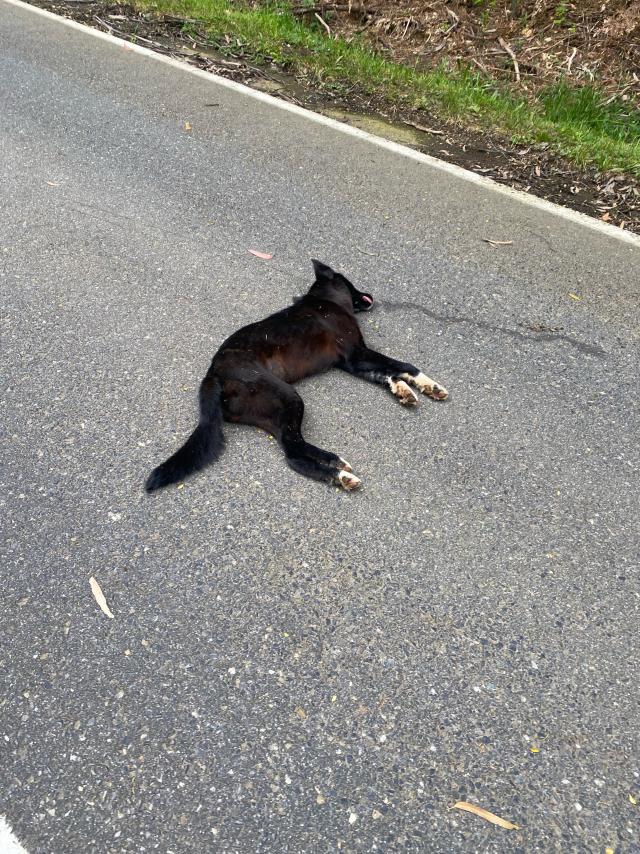
The discovery of a dead dingo on Mount Donna Buang Road has prompted calls for awareness surrounding the importance of dingo genetic studies.
Georgia Ryan, who is the director of an animal behaviour consultant company in Seville, was driving along Mount Donna Buang Road when she came across a dead dingo in the middle of the road.
“I had a look, and at first glance, I was very certain that it was not a feral dog, and it looked to be a dingo,” Ms Ryan said.
Recognising the dingo’s potential significance, she contacted Wildlife Victoria who forwarded her on to the Australian Dingo Foundation to report the finding.
“I wanted to make sure that someone was notified so that they could gather some data… I just wanted to make sure that I contacted the relevant people so that they were aware that it was likely a dingo that was found in that location.”
Victorian National Parks Association (VNPA) parks and nature campaigner Jordan Crook was notified about the dingo and went to collect a DNA sample.
“I was told about the dingo that was killed in the national park up there, so I collected a small sample… which is a six centimetre part of its ear that then gets dried out and sent to academics who are doing studies on the genetic health of dingo across Australia,” Mr Crook said.
The DNA sample will contribute to a study by the University of New South Wales (UNSW) which will analyse the genetic purity of dingoes in Australia.
Led by Dr Kylie Cairns, the research expands on her earlier study which changed the consensus that dingoes and wild feral dogs frequently interbreeded.
It was thought the purity of dingoe’s genetics was relatively low given the assumed high rate of interbreeding, but the 2023 study revealed the complete opposite.
This meant most animals previously thought to be wild dogs, are in fact likely to be dingoes.
“We need to collect as many samples as possible. I would definitely encourage anyone who has seen a road kill dingo in their area, or they shot them because of their impact to their livestock, to help collect those samples,” Mr Crook said.
Ms Ryan said she shared the post about the dead dingo on Facebook to educate people on what to do when they come across one themselves.
“By sharing this message… they can go through the appropriate channels to then report sightings or deceased dingoes. So again, we can gather more data around what dingoes are out there in the environment.”
Dingoes are apex predators in Australia and are crucial at keeping wallaby, kangaroo and wombat populations in balance.
Alongside the dingoe’s significant cultural importance to Victoria’s First Peoples, dingoes are protected threatened wildlife under the Wildlife Act 1975 and listed as ‘Vulnerable’ on the Flora and Fauna Guarantee Act 1988 Threatened List.
Research by DEECA’s Arthur Rylah Institute (ARI) revealed critically low dingo populations in north west Victoria (between 40 and 230) while populations in east Victoria remained stable (2640 to 8800).
Ms Ryan said it made her “quite sad” to see the dead dingo considering its vulnerability.
Those who come across a dead dingo are encouraged to report it to the Australian Dingo Foundation on 03 5428 1245, or Victorian National Parks Association, on 03 9341 6500.